BLOG |
|
By Carly Phillips 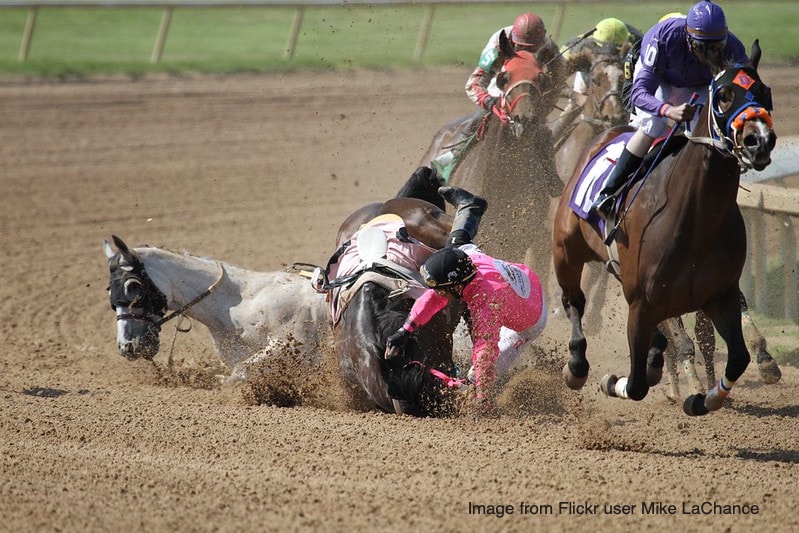 When a person is asked to think about exploited non-human animals used for entertainment, the brain usually goes to the most well-known cases. The whales and dolphins in their fishbowls in Sea World. The animals cramped in cages in zoos all across the country, across the world. The elephants and lions and tigers who have all of their natural instincts “trained” out of them, so they are docile enough to be let in front of a crowd. However, no one usually gives a second thought to horses bred for racing. Why would they? Horse racing is just a sport, it’s fun for all parties involved. Apart from the fact that, on average, close to ten horses died each week at American racetracks in 2018. If you do the math, that’s five hundred and twenty horses dead in a year. These deaths are due largely to unnatural reasons that are directly connected to the act of racing, and that is why racing needs to be outlawed in the United States. Horse racing is an extremely old sport, and while it can be hard to pinpoint the first ever horse race, the first horse race held in the U.S was in New York in mid-sixteen hundred. The most commonly known form of racing is called a flat race. This type of race is what is usually shown in movies and television. Flat races are when the horses run on a completely flat track. According to a figure on the EQUIBASE website, by the time 2019 is up, there will have been 136 tracks that held horse races held across the nation. This may not seem like that big of a number, but that is only the number of places where these races are held. Racetracks usually hold races for large chunks of time, sometimes months long. In addition to that, there is more than one kind of race the horses can be forced to compete in, which only further adds to that number. 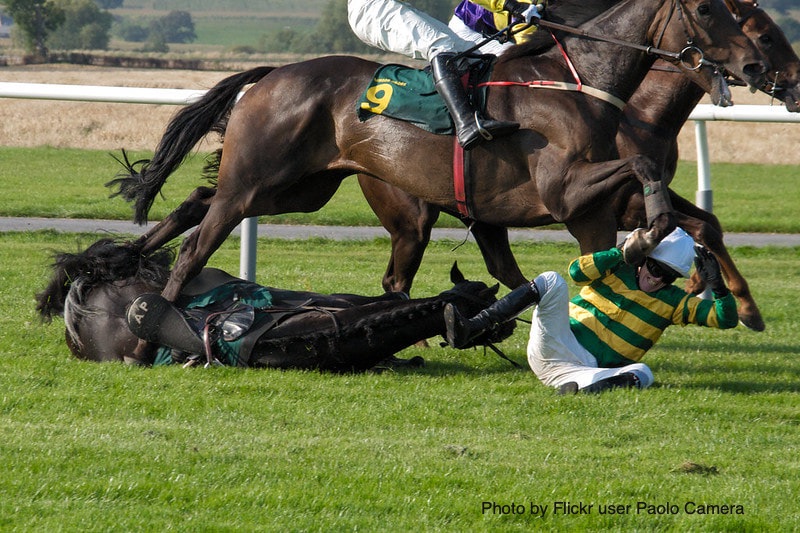 As the number of deaths of racing horses in a yearlong period would suggest, horse racing imposes an unnatural danger to the horses who are made to participate. But the danger starts much earlier than the time horses are first put on the track. The ideal age for racing horses is two to three years old. These young horses are subjected to intense training programs to get them ready to compete. Because they are so young when they begin their training, the rigoristic workouts put a lot of strain on their bones, which are not fully developed at that point. This in turn can make them more likely to suffer an injury later in their racing career. Only horses who emerge from this training period without serious injuries are allowed to race. Many horses in the U.S are injected with performance enhancing drugs to better their odds of winning. In addition to this, they are also sometimes given painkillers that can make them race through injuries, exacerbating an existing injury or make the horse unable to notice a new injury they may have sustained during the race. Unfortunately, most injuries for racehorses are fatal. Despite a push for legislation to outlaw the use of performance enhancing drugs in 2011, it is still legal to administer them to participating horses even on the day of a race. In addition to being dangerous for the horses, racing can be dangerous for the jockeys, the people who ride the horses, as well. A study conducted in California from 2007 to 2011 showed that in Thoroughbred races, which are the most common, a jockey will have 1.99 falls for every one thousand races. However, over fifty percent of those falls will result in an injury for the jockey. Most of these injuries happen in the legs. (Hill et al, 2003). And if an injury is severe enough where they jockey has to take time off of work, that adds a cherry on top of a rather disappointing sundae, because jockeys are reported to be some of the worst paid professional athletes. The majority of these falls are because of catastrophic injury or sudden death of the horse themselves. (Hill et al, 2003). So, you have this sport that’s not very good for the horses, not very good for the jockeys, and yet it makes a ton of money and is attended by a huge amount of people. Because it’s a sport, it’s fun to watch the competition, it’s fun to bet with your friends and family on which horses you think will win. When I was a preteen, my parents and my older brother and I actually went to Canterbury Park to celebrate Family Day (my parent’s anniversary and the day I was adopted, thus completing our family). We would all pick a horse, and then bet a certain amount, under five dollars, that that horse would win. If they did, all the other members of the family had to give pay that person the betted amount. I didn’t end up making a lot of money, but despite that this memory is an extremely fond one. So, the appeal of attending a horse race is understandable to me. But had my family and I gone to a play? Or gone on a walk, or to a restaurant? It would still have had a happy memory shared with loved ones. And although it was unknown to me at the time, us being at the race was just contributing to an industry that values profits over non-human animals’ well-being, and sometimes human ones. This on top of the fact that innocent animals are getting injured and dying because we want them to entertain us is something that is hard to get behind and does not seem worth it in the long run. ReferencesAmerican Horse Racing vs. the World: What’s the Same, What’s Different. (2017). Retrieved from https://www.americasbestracing.net/the-sport/2017-american-horse-racing-vs-the-world-whats-the-same-whats-different Drape, J. (2019). Horse Deaths Are Threatening the Racing Industry. Is the Sport Obsolete? Retrieved from https://www.nytimes.com/2019/04/29/sports/horse-deaths-kentucky-derby.html George, R. (2001). Young Horses in Training and Injury Risks. Retrieved from https://thehorse.com/14193/young-horses-in-training-and-injury-risks-2/ Hill, A. E., Hitchens, P. L., Stover, S.M. (2003). Jockey Falls, Injuries and Fatalities Associated with Thoroughbred and Quarter Horse Racing in California, 2007-2011. Orthopaedic Journal of Sports Medicine, volume 1. https://doi.org/10.1177/2325967113492625 Isidore, C. (2015). The Derby’s dark side: Jockeys are the most injured, underpaid pro atheletes. Retrieved from https://money.cnn.com/2015/05/01/news/companies/jockeys-risks-pay/index.html Racing Dates. (n.d). Retrieved from https://www.equibase.com/products/racedates.cfm Support the Interstate Horseracing Improvement Act of 2011. (n.d). Retreived from https://www.humanesociety.org/sites/default/files/docs/2011-horseracing-improvement-act.pdf Author BioCarly Phillips is a junior at MNSU Mankato. She has loved non-human animals for her entire life and knew from a young age she wanted to have a career working with them someday. She is currently working toward a degree in Zoology and looks forward to learning as much as she can about non-human animals while she is in school and hopefully, one day, accepting her dream job of working in a wildlife sanctuary.
Comments are closed.
|
ABOUT
This is a website about nonhuman animals, written by human animals taking a Society and Animals class at Minnesota State University, Mankato. Archives
November 2024
Categories
All
|
 RSS Feed
